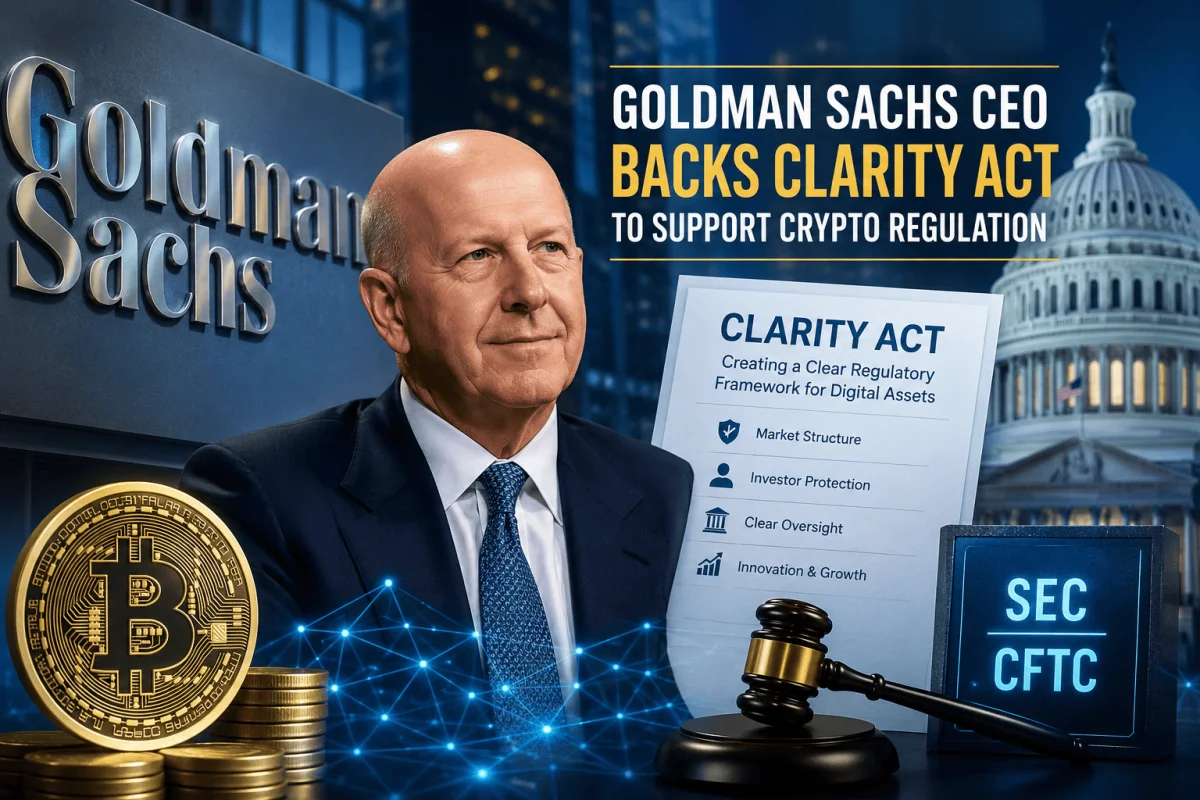
Goldman Sachs Chairman and CEO David Solomon has expressed his support for the CLARITY Act, giving one of Wall Street's biggest financial institutions a voice in favor of new U.S. crypto regulations.
Speaking about the bill, Solomon said:
“I’m very supportive of moving the Clarity Act forward, so we can get some market structure in place and start to move the innovation process along.”
He admitted that the bill is not perfect but believes it is an important step toward creating clear rules for the digital asset industry. According to Solomon, better regulations would make the crypto market more stable and encourage innovation. It would also allow more regulated financial institutions to take part in the digital asset market.
Banks Remain Divided on the Bill
While Goldman Sachs supports the CLARITY Act, several major banking groups continue to oppose parts of the legislation.
Their main concern is that crypto companies could offer interest or reward programs for customers holding U.S. dollar-backed stablecoins. Banking organizations argue that this could encourage people to move money out of traditional bank accounts, reducing the deposits banks use to provide mortgages, business loans, and other types of lending.
Groups including the American Bankers Association, Bank Policy Institute, Consumer Bankers Association, Financial Services Forum, Independent Community Bankers of America, and National Bankers Association have all raised similar concerns.
Unlike retail banks, Goldman Sachs relies less on consumer deposits. Instead, the investment bank has focused on the opportunities that blockchain technology and digital assets could create for regulated financial institutions.
Senate Debate Continues
The U.S. House of Representatives has already approved the CLARITY Act, while the Senate Banking Committee advanced its own version earlier this year.
On July 22, Republican senators released an updated draft after discussions with lawmakers, financial regulators, law enforcement agencies, banks, consumer groups, and crypto companies.
The revised bill aims to create a clear regulatory framework for digital assets. It would define the responsibilities of the Securities and Exchange Commission (SEC) and the Commodity Futures Trading Commission (CFTC), while also setting federal rules for crypto exchanges and other digital asset businesses.
However, the bill still faces challenges in the Senate.
Critics argue that it does not include strong enough ethics rules for government officials and their families. They also say important issues such as stablecoin rewards, financial crime prevention, conflicts of interest, and law enforcement powers still need to be addressed.
Goldman Continues Growing Its Crypto Business
Goldman Sachs' support is significant because of its size and influence in global finance.
At the end of the second quarter of 2026, the company managed $4.04 trillion in assets under supervision, an increase of $391 billion during the quarter.
The firm has also been expanding its presence in the crypto industry. Recently, Goldman partnered with Apex Group and Archax to launch an institutional tokenized real estate fund using its blockchain-based digital asset platform.
In addition, Goldman Sachs Asset Management has applied to launch a Bitcoin premium income ETF. The proposed fund would use a covered-call strategy linked to Bitcoin to generate income while also offering the potential for long-term capital growth.
The move comes as competition in the crypto ETF market increases, with BlackRock launching its own Bitcoin income ETF earlier than Goldman. As more major financial firms enter the digital asset space, many industry leaders are calling for clearer and more consistent federal crypto regulations.